
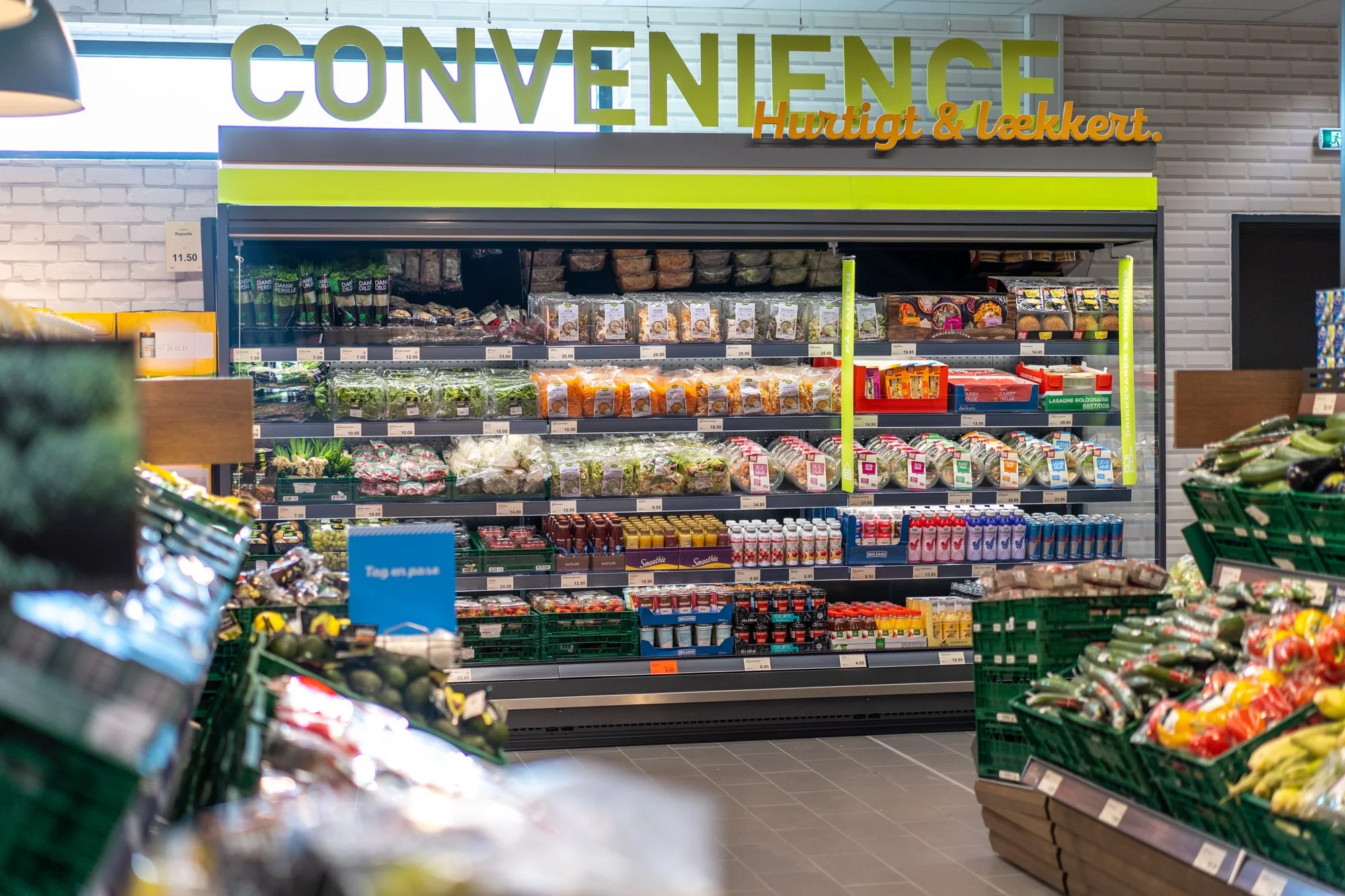

To support Aldi’s work on preventing produce waste in their stores. Identify the points of improvement and provide a feasible and sustainable solution for the problem.
In this project, we explored the phenomena of edible fruits and vegetables wasted at discount retail stores in Denmark. This case study is conducted in the context of ALDI Denmark. We, as a design team sought to create a solution to sell products that would otherwise be wasted. The outcome is the concept Ripe n Ready food box, as well as recommendations for policymakers and retailers.
-
Location - Copenhagen, Denmark
Project team - 5 members
Timeframe - 5 months
Stakeholders - ALDI, Food Bank, Rude Food, customers, dumpster divers, store employees, policymakers.
Methods - Desk research, literature review, interviews, observations, workshops, co-design, brainstorming, affinity diagram, prototyping, service blueprint, testing with users.
-
• Analysed the broader food system, food waste and strategies that have been employed to tackle this phenomenon
• Reviewived the regulatory environment that has implications on the project
• Planned and conducted weekly meetings and interviews with key stakeholders
• Observed and documented processes within ALDI's store as well as dumpsters and dumpster diver's practices
• Prototyped with ALDI's employees and customers possible concepts
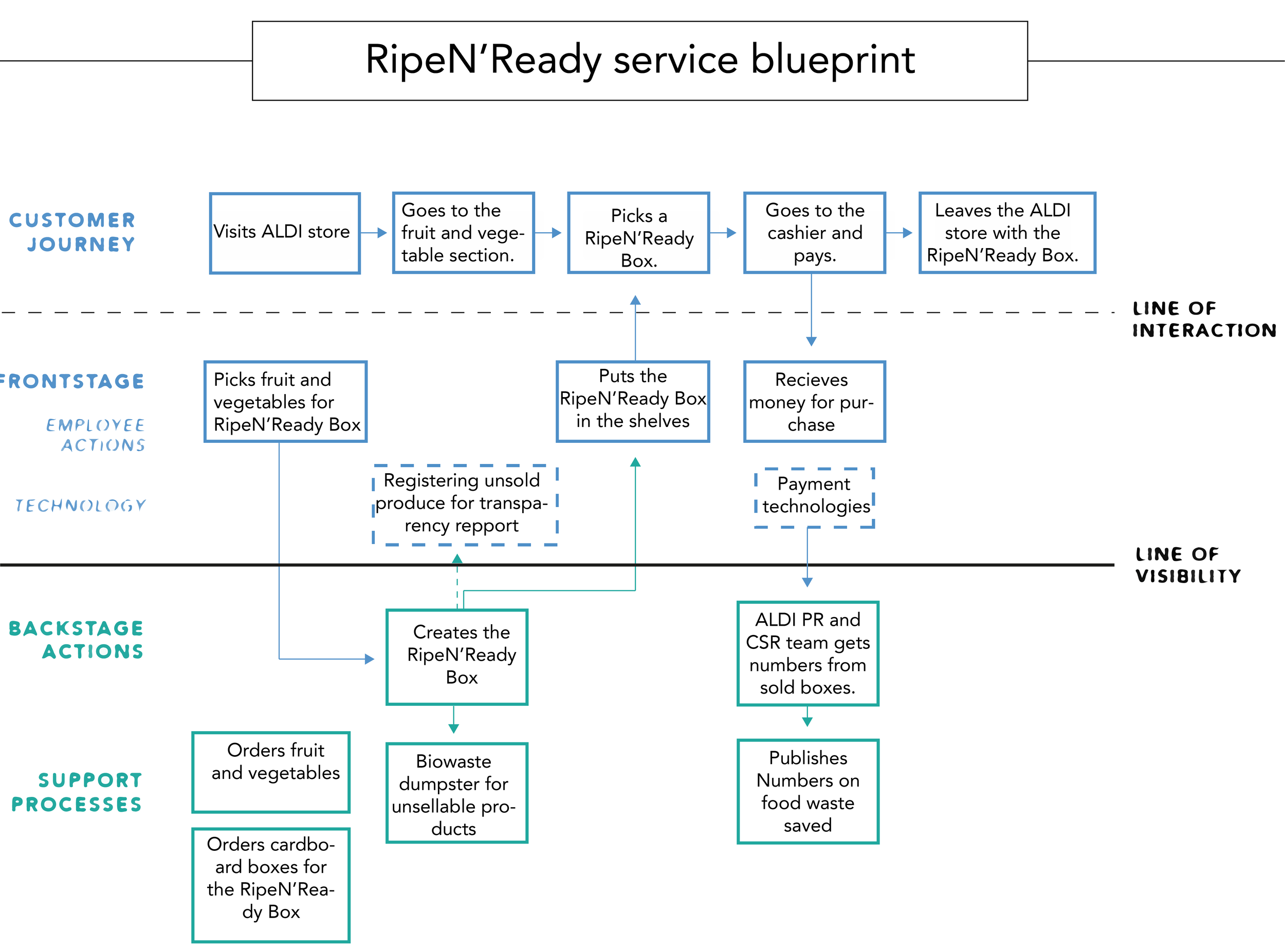
• Designed a service blueprint and a customer journey
A local and global phenomenon
It is estimated that globally, one-third of food produced for human consumption is wasted, and almost half (45%) of fruits and vegetables. This is a systemic issue contributing to climate change and environmental degradation. The Danish food supply chain generates about 716,000 tons of avoidable food waste annually, and approximately 23% of the waste is generated in the retail and wholesale sector. Of all the avoidable food waste generated by the wholesale and retail stores, 38% is fruit and vegetables, which is set to be the largest category by volume.
Causes for produce waste in the Danish retail stores
-
Food waste is especially an issue within discount stores. Discount stores typically don’t have optimal ways of dealing with their unsellable produce, for example, an internal kitchen, that could cook the unsellable produce.
-
As a part of the food culture in Denmark, expecting full shelves throughout all opening hours of the store and having high cosmetic standards, are noticed to be common expectations from the customers. These high standards are factors contributing to greater pressure on the discount stores. This forces the stores to order more food than they can manage to sell in time.
-
The current laws state that if supermarkets want to give the food away to the general public, due to Danish Tax regulations, they need to pay VAT to the government. VAT is 20% of the good’s selling price. Therefore, this provides a barrier to donating food. Instead, throwing food out becomes a cheaper and easier alternative.
-
• Pre-packed produce gets thrown out if one fruit or vegetable goes bad
• Customers are picky and likely to choose the newest produce
• Over ordering leads to waste
• Long-distance and complex supply chain
Mapping the food system
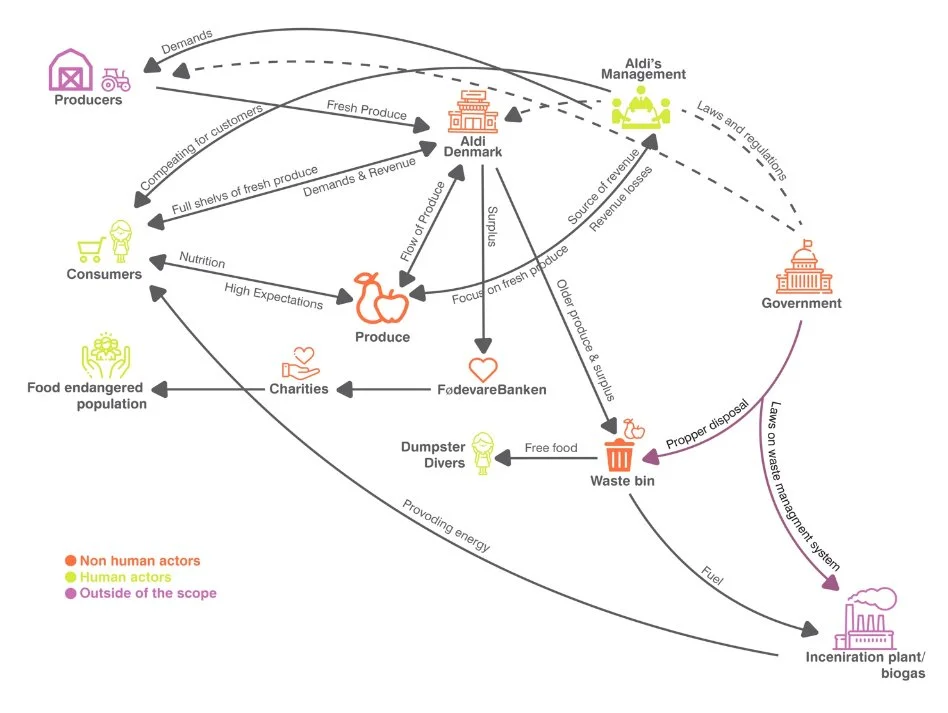
The project began with an effort to develop a broader understanding of produce turned into food waste through desk research as well as initial interviewees with the main stakeholders. Following this, we were able to map out the important relations that influence the food system in Denmark
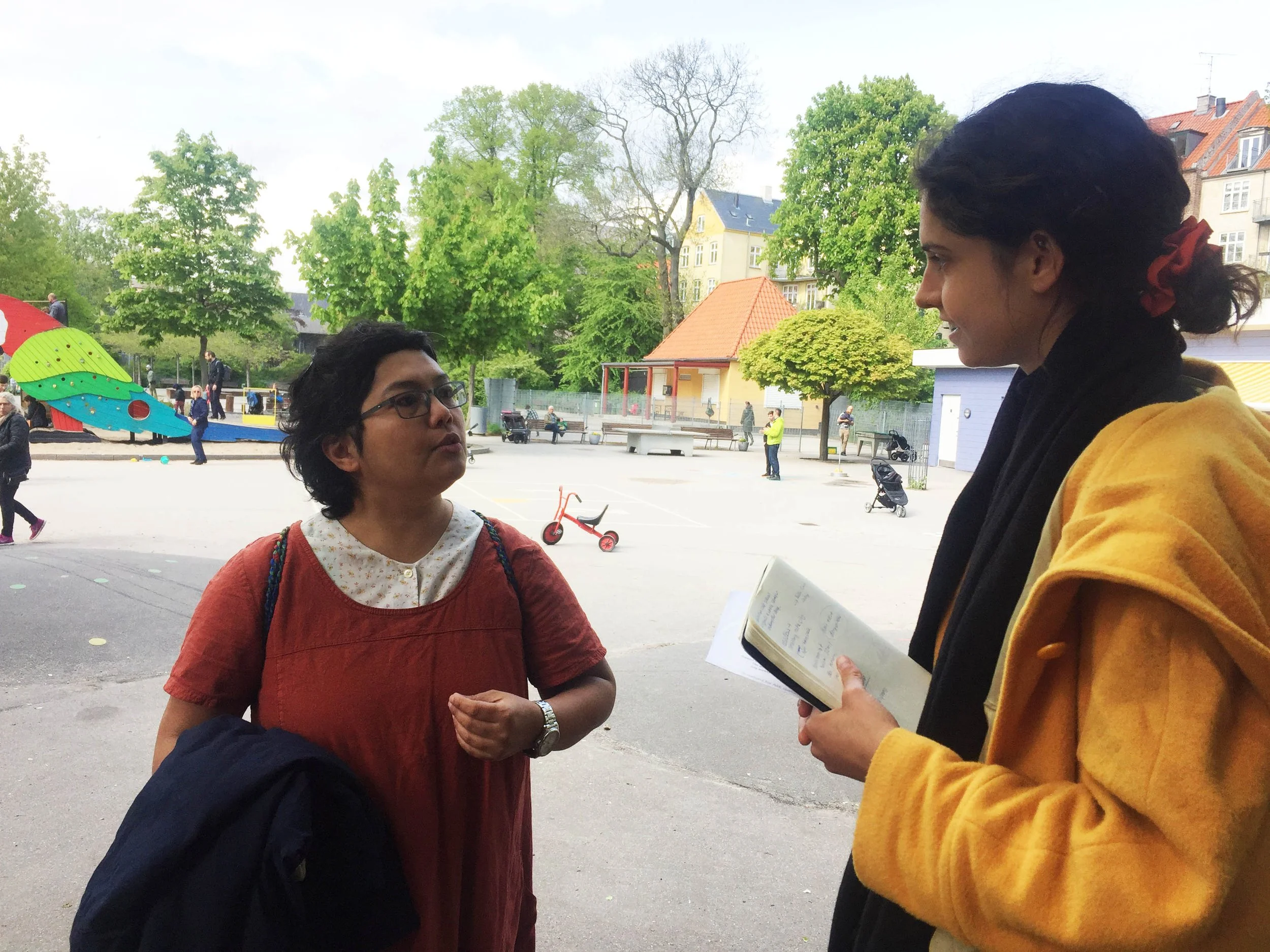
Interview with the Zeenath Hasan, the founder of Rude Food
Fieldwork
A variety of stakeholders were consulted and observed to understand their worldviews and imagine how the relations might look in the future. These include store staff, managers, customers as well as Rude Food, a start-up working to re-sell food that would otherwise be wasted.
All of them provided valuable information that offered a broad range of insights and inspiration for the design development. In this case, the design team played a role of a ‘glue’ trying to gather all different perspectives to create new possible concepts.
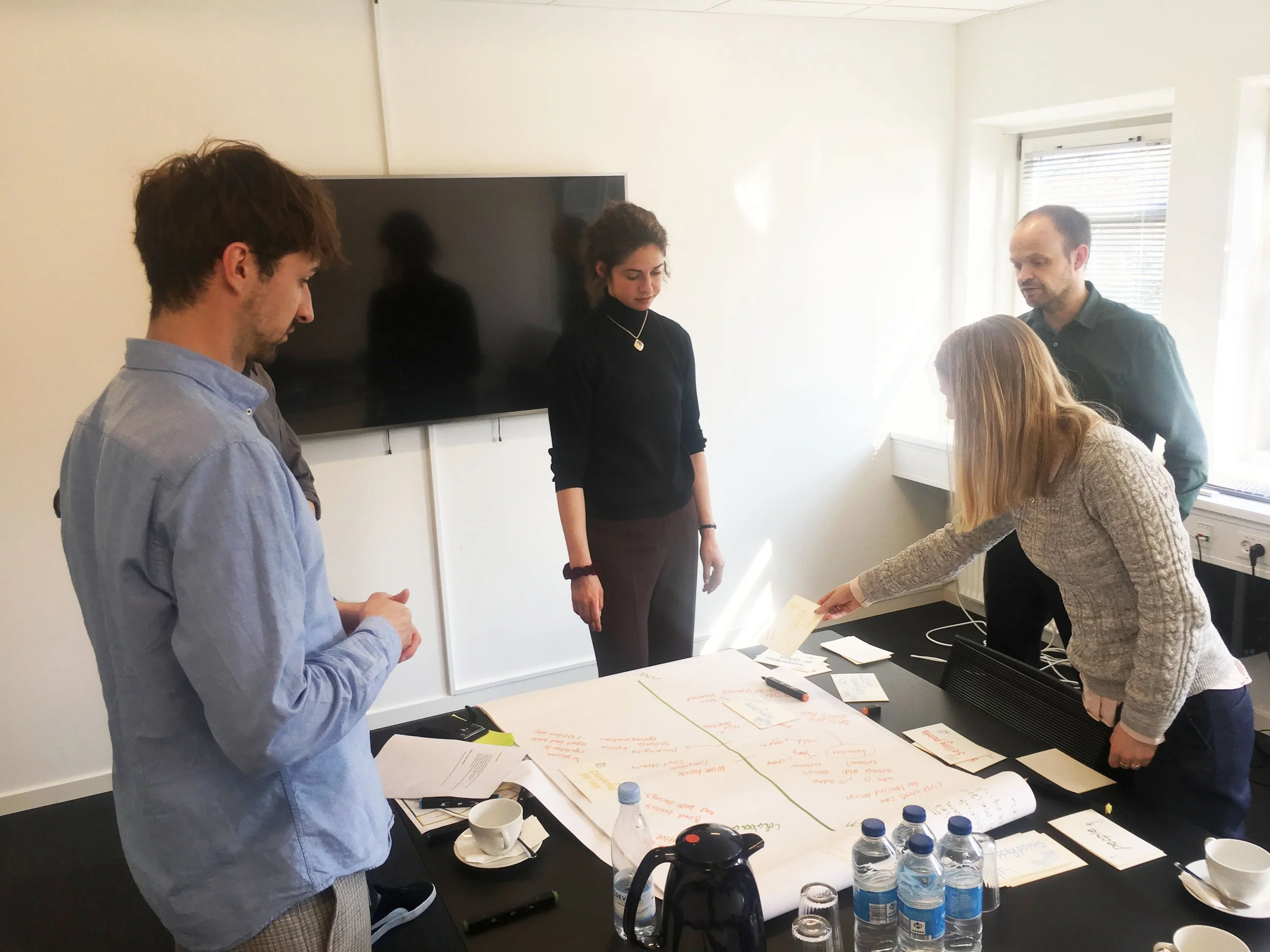
Focus group meetings
To ensure that the future solution derived from this project fits into the context and solves the phenomena it was chosen to have a high stakeholder involvement. We created a simple design game to facilitate conversation about the project, future scenarios and the studied phenomena to the included stakeholder’s expertise.
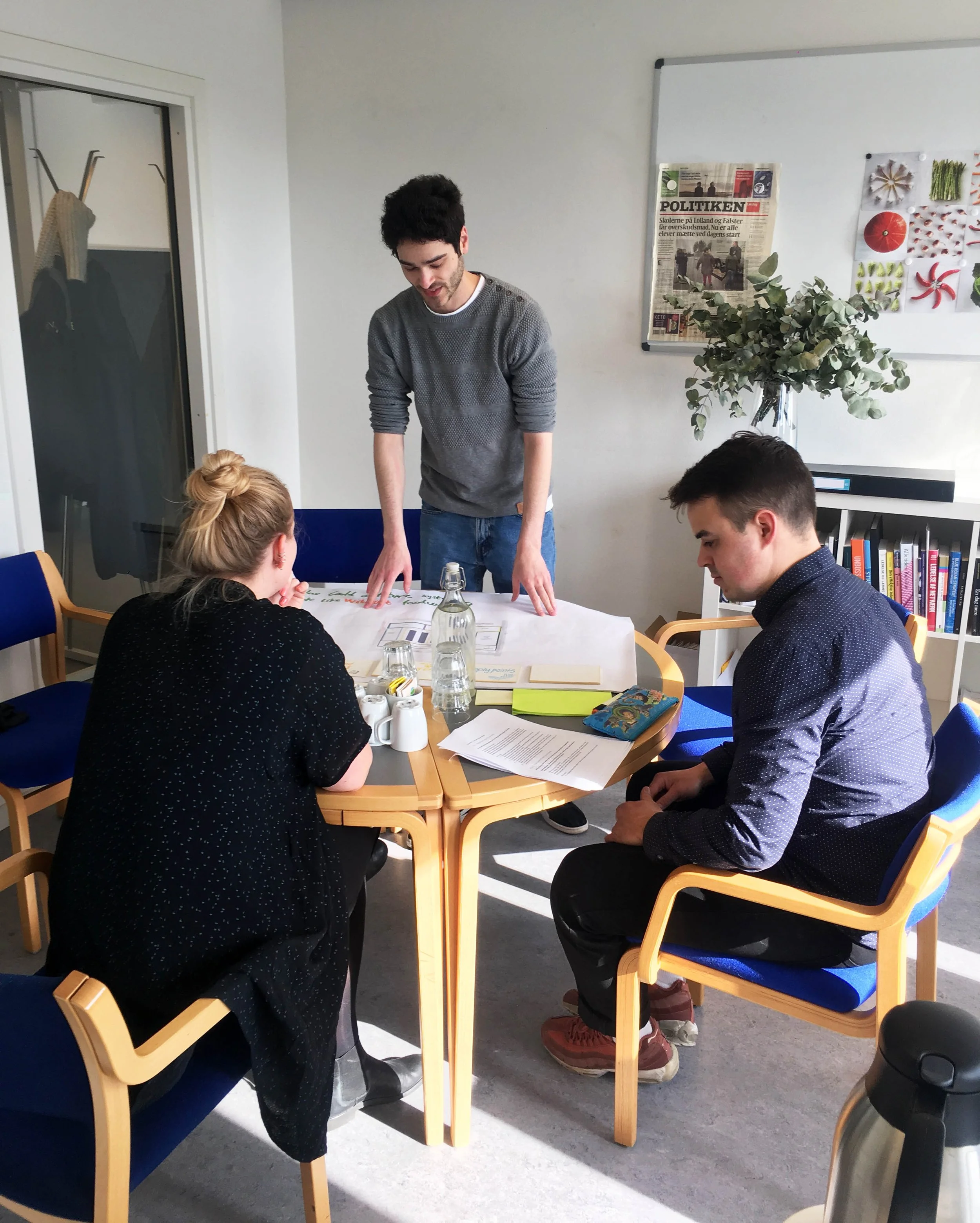
Workshops at ALDI and Food Bank headquarters
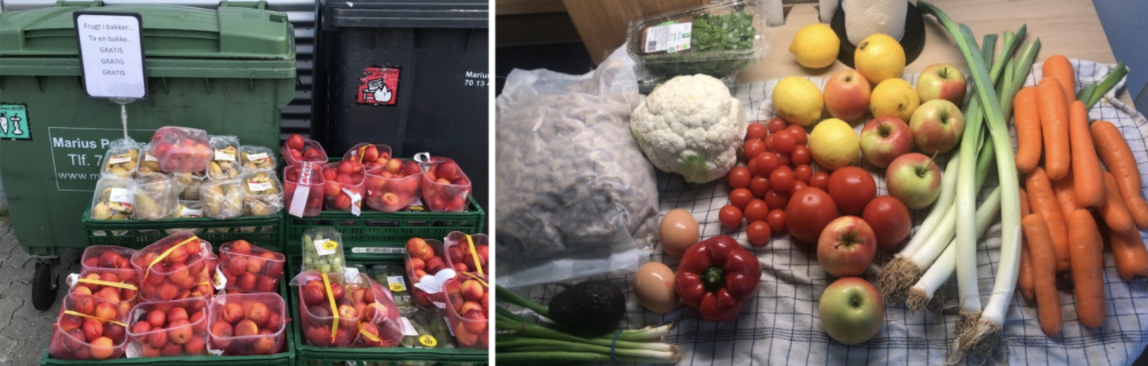
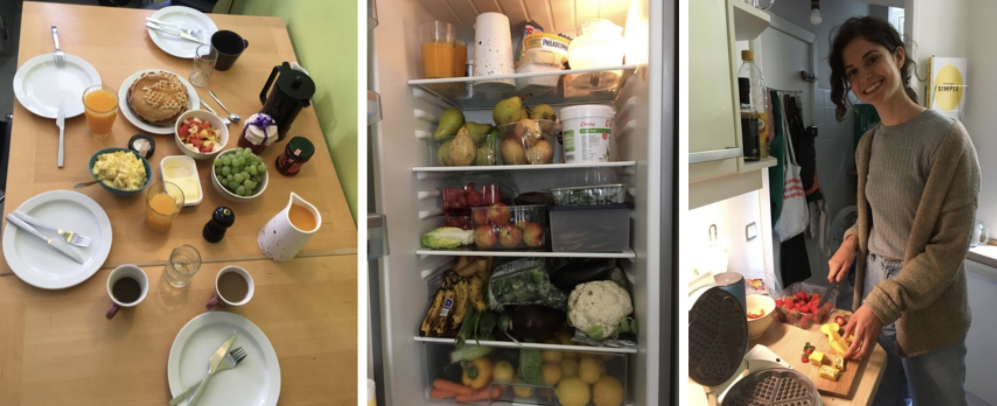
Dumpster brunch experiment
Throughout the project, we observed how much of the edible food ends up in the dumpsters of discount retail stores. We also got a chance to talk with dumpster divers who come regularly to these sites. By the end of the observations, we collected what we could find and gathered to cook the food together. The result was a large meal of a variety of fruits, rhubarb compote, freshly squeezed orange juice (made with found oranges), eggs, bread, coffee, and pancakes (cooked with found ingredients).
Affinitization
The results from the research phase gave us insight and new knowledge of the field of study. To handle and analyze the vast amount of information, we created an Affinity Diagram.
We took all the data points from every interview/observation activity and wrote them on an individual piece of paper. Once noted, they were grouped into categories with commonalities and described what that group is about. After refining this process several times, we landed on our key insights, which led us to our design framework.
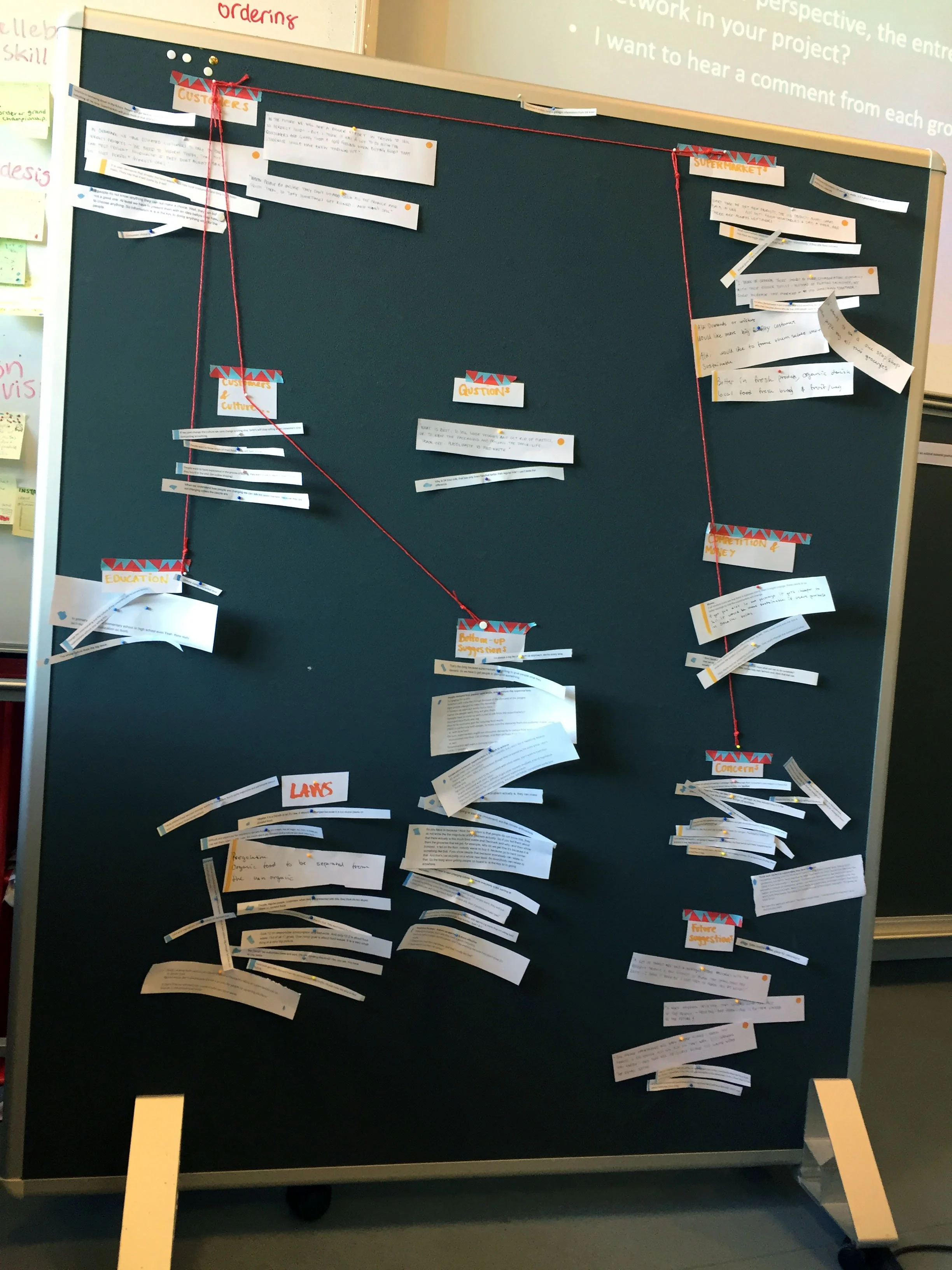
Affinity diagram board
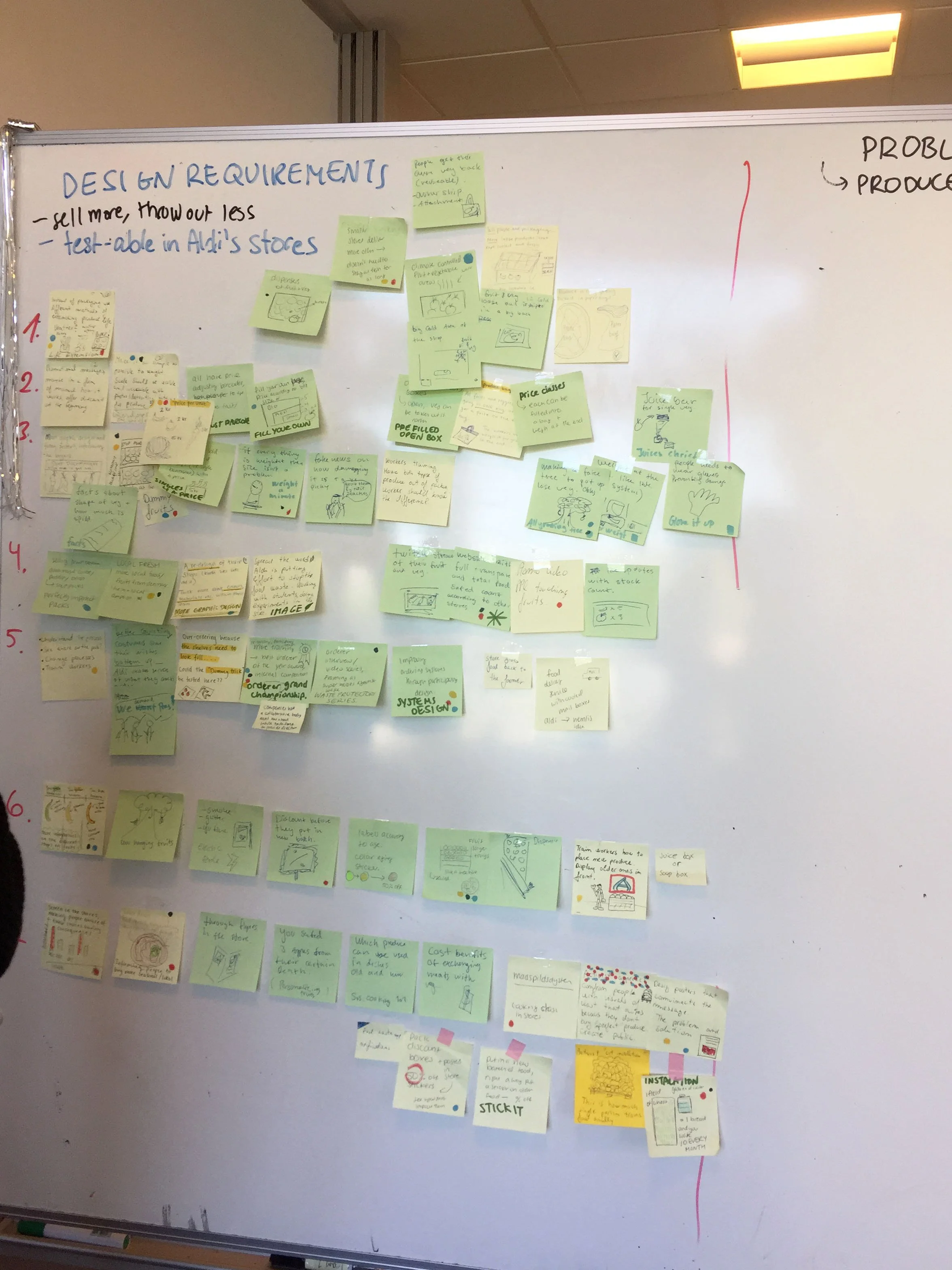
Design requirements board
Ideation
The overall criteria for the concepts were that it should be a feasible solution within a discount store. Prior to the brainstorming, we reviewed a list of problem areas found in the affinity diagram and created a list of design requirements.
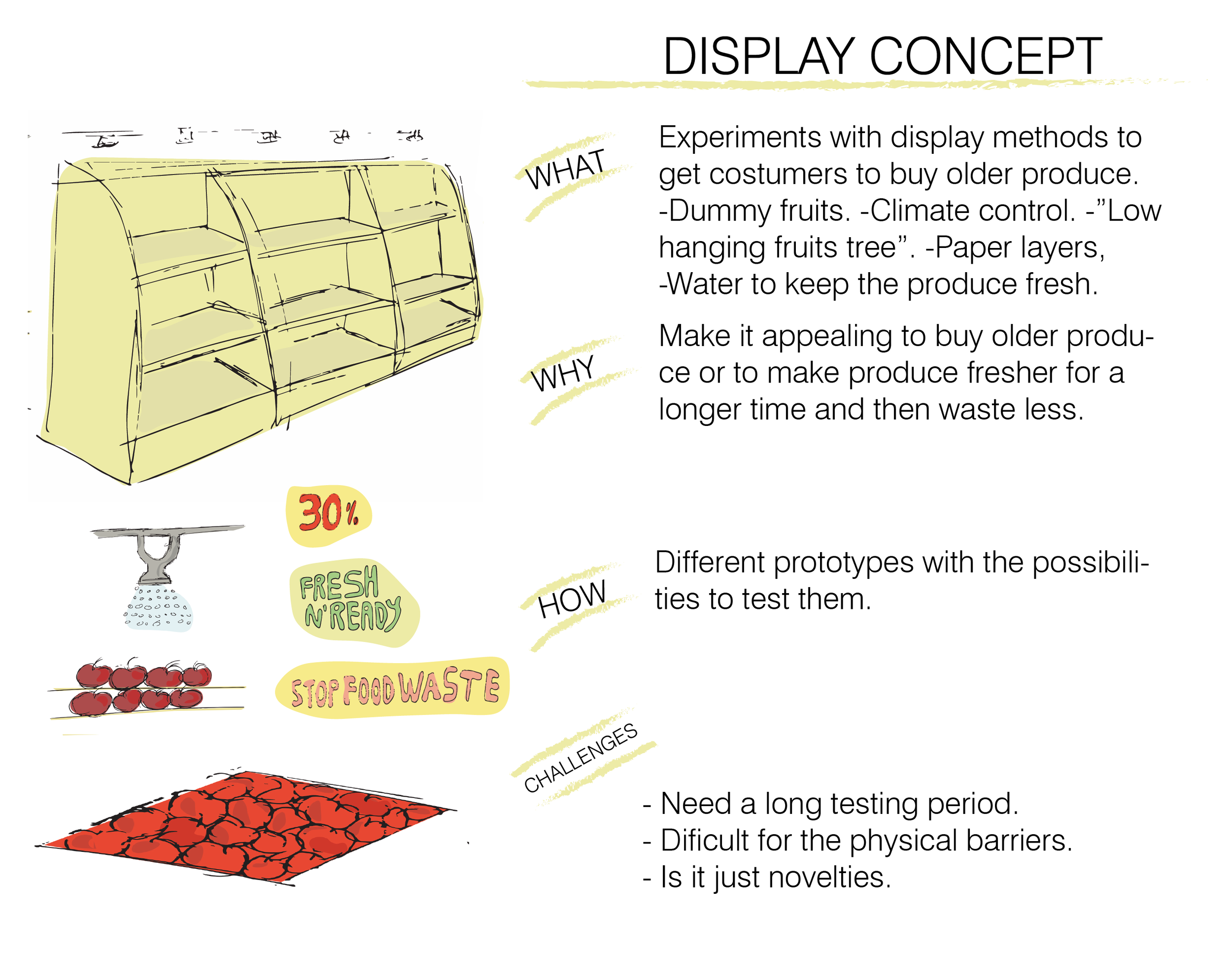
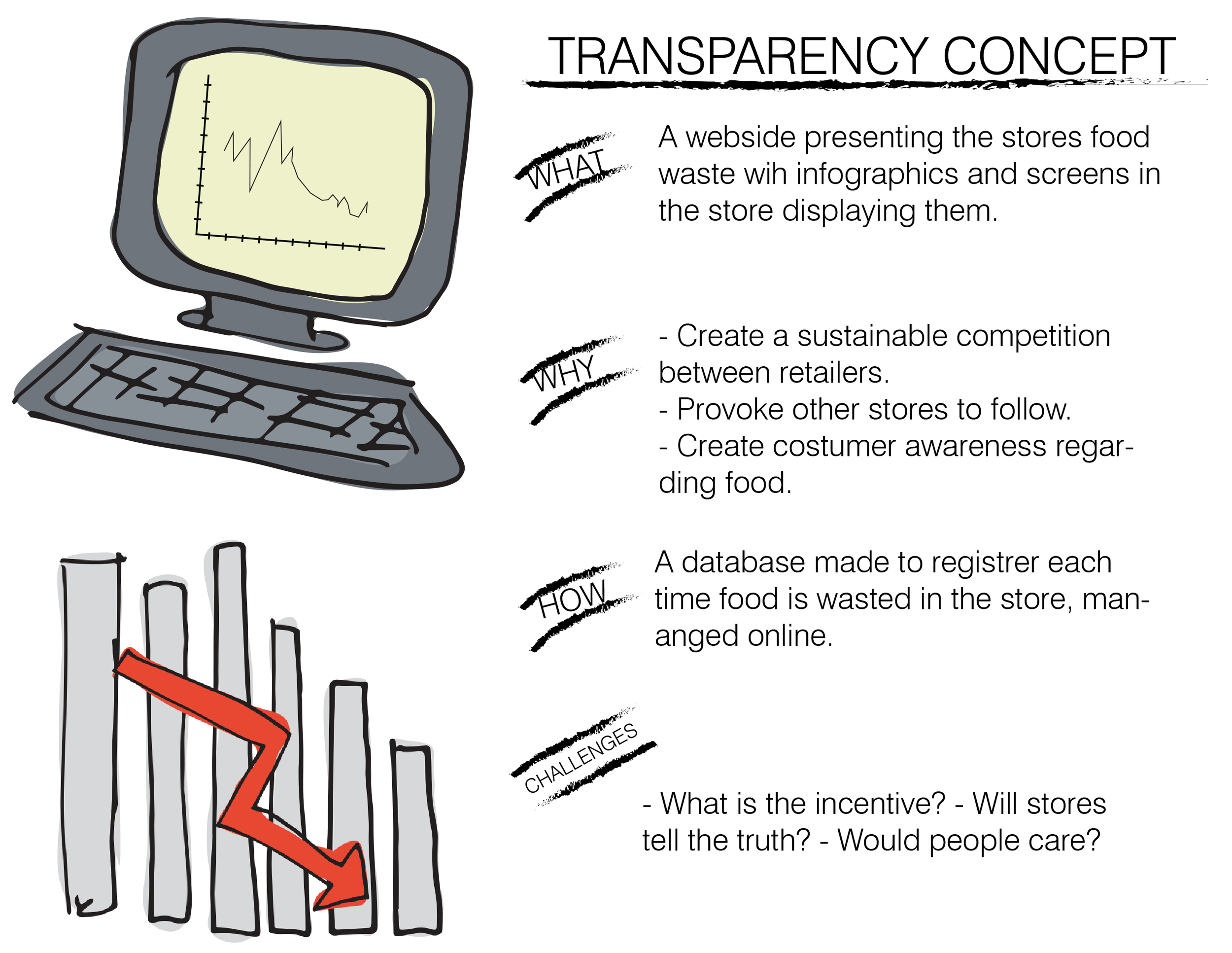
A timer of 2-3 minutes was set for each brainstorm of the chosen problem areas. It was agreed that each of us should try to create both an experimental concept and a more feasible concept for each brainstorming process. When the time ran out, each participant was to elaborate their concepts while putting them up on the whiteboard. Each of us got 2 votes for each problem area solution and the concepts with the most votes were selected to be iterated in a new development process. This led us to create 4 different concepts which had the potential to be implemented at the ALDI store.
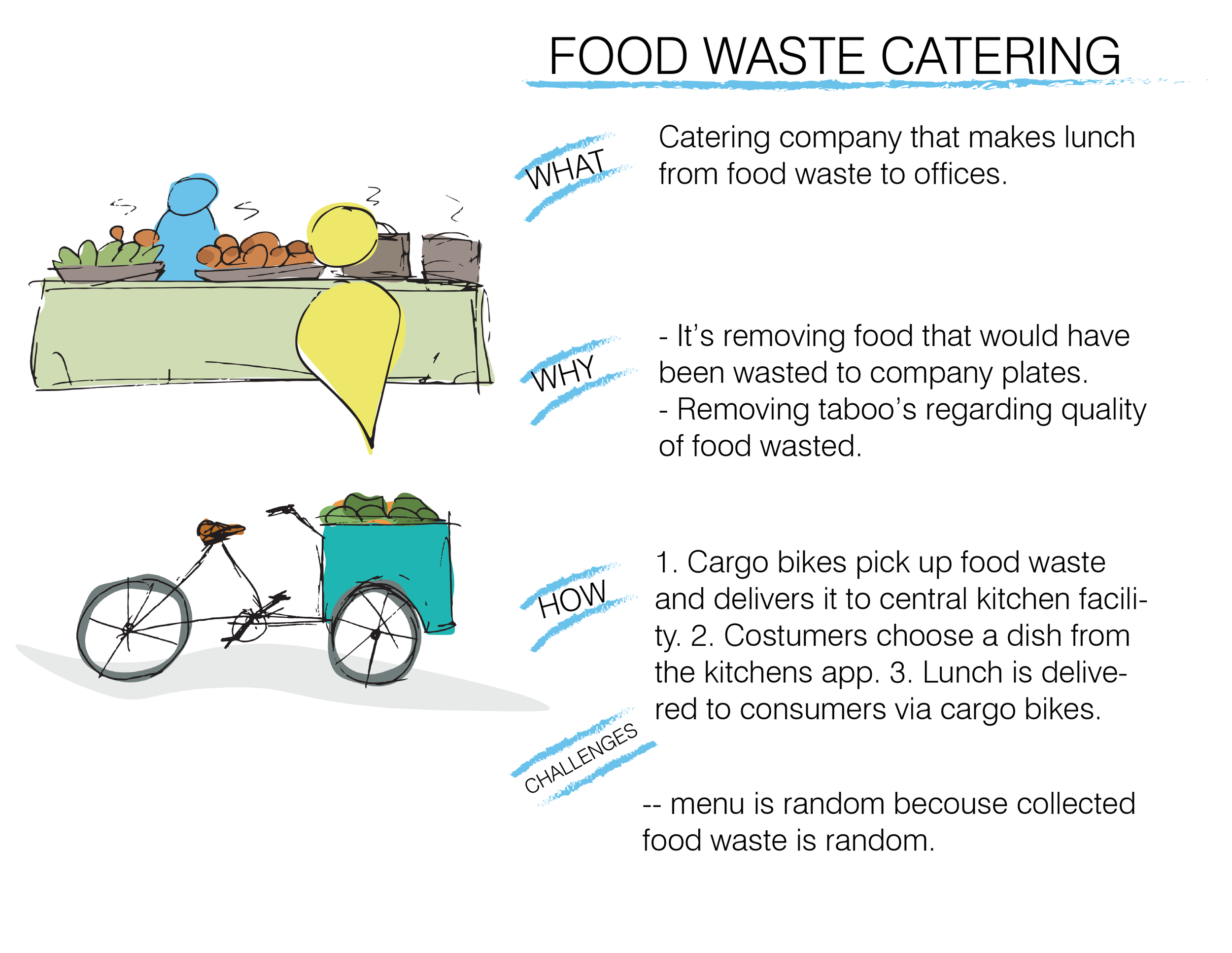
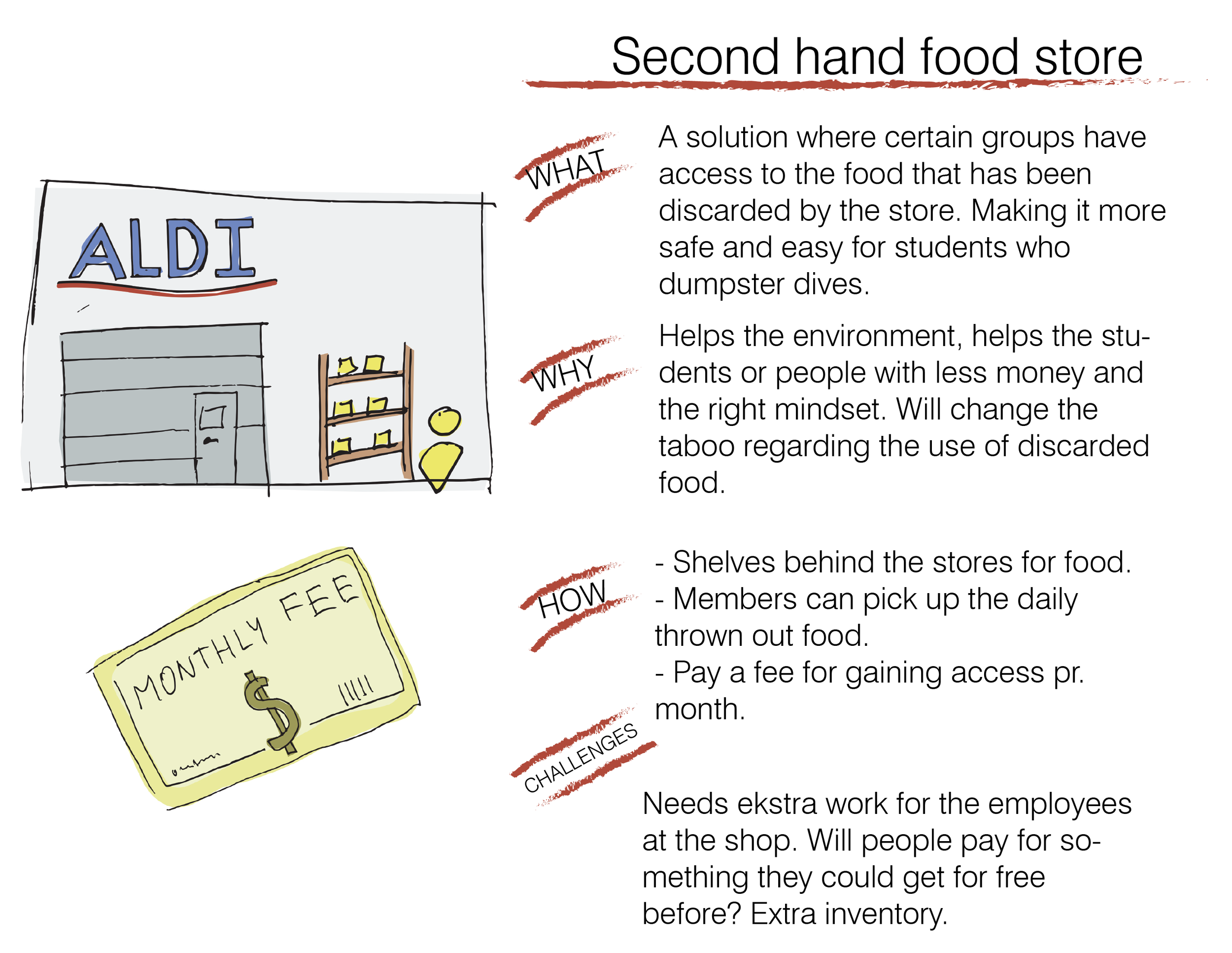
Ripe n’ Ready - the final concept
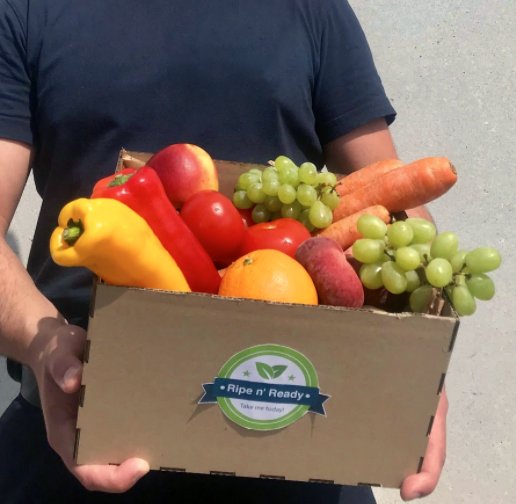
Functions from each concept were selected and channelled into the final concept. This led to a solution created called the Ripe n’ Ready food box, which creates an opportunity for retailers to sell discounted produce before it becomes wasted. In particular, this solution addresses the problem of multi-packs of produce where one goes bad, and the entire package is thrown away.
Our research showed that discount stores have limited resources, which is why the Ripe n’ Ready Box only requires minimum resources from the store employees.
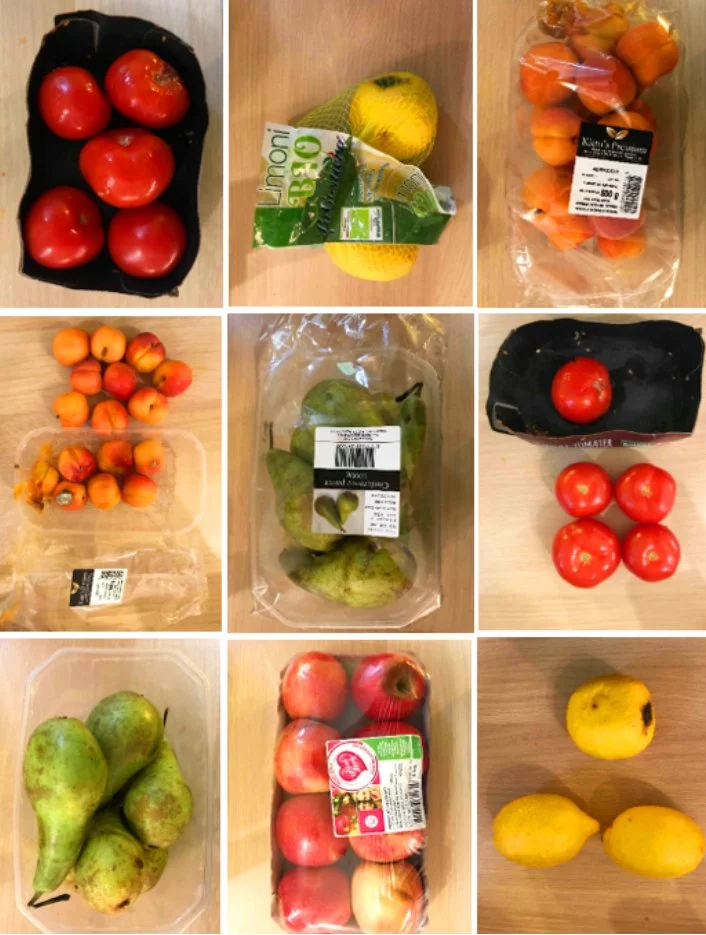
Disposed multi-packs/pre-packed produce
Estimate
Approximately 6.600 kg of perfectly fine produce is thrown out in a single store each year. Each of the boxes would be fitting approx.1 kg. Based on these calculations, we estimate that the ALDI store would produce an average of 126 Ripe n’ Ready boxes each week.
Framing
-
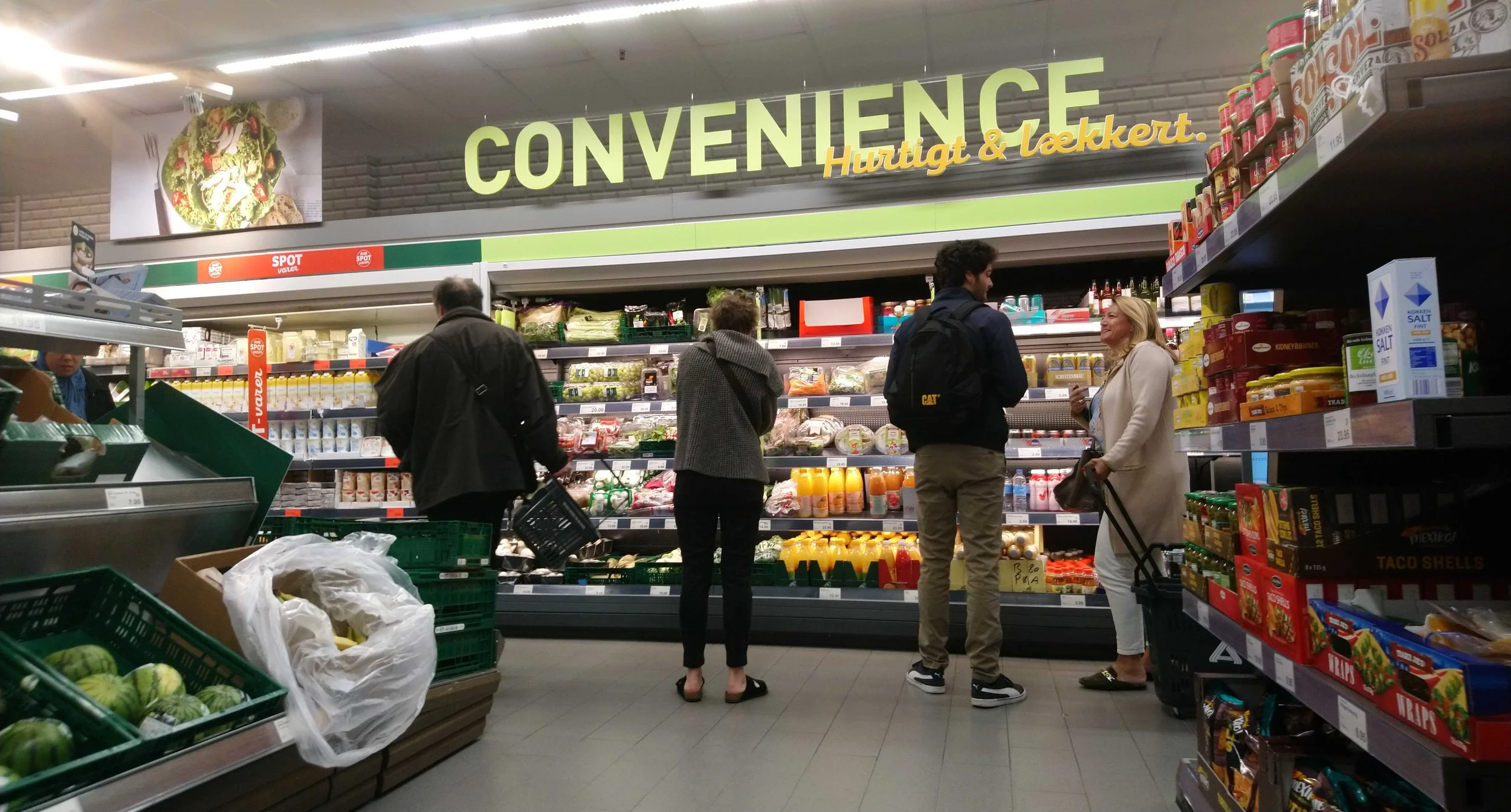
We acknowledge the importance of placement in the store and it is recommended that the shelving display is placed at the beginning of the produce section in regard to the entrance of the store. This will ensure that customers see the solution before they start shopping for produce. The intention is that it will inspire customers to buy the Ripe n’ Ready Box instead of buying the same ‘new’ products.
-
The shelving unit should reflect a new and green initiative but should also reflect that the product is still fresh and ready to eat.
-
ALDI’s Instagram or a smartphone app can be used to inspire customers with different recipes that can be cooked with elements of the Ripe N’ Ready box. We recognize that the content of the boxes will change from day to day and from store to store, therefore it is important that they have multiple recipes available that can inspire customers.
Testing with customers
The concept was presented with printed out illustrations where the customers were able to choose between different options on whether the box should be a ‘pick-the produce yourself’ or a ‘pre-packaged’ solution, how much they would pay for the box and if they preferred to have a subscription service or only pay for the boxes they buy.
The vast majority of the interviewees preferred the ‘pick-yourself’ box
The monthly subscription was too committing
The average price came out at 24,6 DKK
Concept review at ALDI headquarters
From Aldi, we received positive feedback and were eager to continue the project and prepare it for implementation. They recommended the future steps would be to create an implementation plan. This would include testing pricing, the size of the boxes, and considering all the logistics needed to conduct a pilot program in the stores.
PROJECT TEAM
Adam, Albert, Bruno, Julie, & Michelle